Critique DPO
I chanced upon a pretty interesting idea proposed by Peter Hayes (now at Anthropic) in 2025, to more efficiently use feedback data in the standard RLHF pipeline to speed up the whole thing. Basically, given external feedback/critique/verification of generated answers, can we incorporate this feedback in an NLL term in addition to the standard DPO loss; trained on the base model? Most previous efforts either used this feedback to train a better verifier, or used other additional NLL terms in the base model training. I spent couple of months reading around the literature, setting up the HPC infra, and running some experiments. Unfortunately experiments (at least on smaller models) resulted in negative findings - the model was extremely prone to reward hacking…
This post is a summary of the background and results. We go through DPO in quite a bit of depth, cover relevant research, and show reward hacking for our proposed method (Critique DPO).
Introduction
Direct Preference Optimization (DPO) enables fine-tuning language models from pairwise preferences without reinforcement learning, often used in Reinforcement Learning with Human Feedback (RLHF) pipelines to align LLMs with human intent. Instead of human preferences, we may use LLM-as-a-judge workflows, where chain-of-thought reasoning improves judgement quality. Can we leverage the judge’s reasoning — not just its binary label — to improve training sample efficiency when fine-tuning the base model?
We propose Critique DPO (CDPO), which augments the DPO objective with a negative log-likelihood term on the verifier’s chain-of-thought critique, training the base policy to reproduce step-by-step verification reasoning alongside learning from pairwise preferences. We evaluate CDPO against DPO and SFT baselines on Qwen2.5-0.5B-Instruct using 120,000 math preference triples from the GenRM dataset. Our results are a negative finding: the critique term exacerbates rather than mitigates DPO’s reward-hacking failure mode, with CDPO collapsing faster than vanilla DPO on both GSM8K and MATH-500.
Background: DPO
For a given prompt $x$, two completions are sampled from the policy $(y_{w}, y_{l}) \sim \pi_{\theta}(y | x)$ and an oracle judges which it prefers. We denote $y_{w}$ as the preferred completion and $y_{l}$ as the other. This process is repeated over $N$ prompts resulting in the pairwise preference dataset $\mathcal{D} = \\{x^{(i)}, y_{w}^{(i)}, y_{l}^{(i)}\\}_{i=1}^{N}$.
Bradley-Terry Preference Model
We can model the judge preferences using the Bradley-Terry (BT) model, which expresses the probability that completion $y_1$ is preferred over $y_2$ under a latent reward function $r^*$:
$$p^*(y_1 \succ y_2 \mid x) = \frac{\exp\left(r^*(x, y_1)\right)}{\exp\left(r^*(x, y_1)\right) + \exp\left(r^*(x, y_2)\right)} = \sigma\!\left(r^*(x, y_1) - r^*(x, y_2)\right)$$A key property is that BT depends only on the difference of rewards, not their absolute values.
Standard RLHF
The standard RLHF pipeline comprises 2 stages. First, we learn a reward model $r_\phi$ where we find the maximum likelihood estimate (MLE) of $\phi$ under our preference dataset $\mathcal{D}$ and BT model - termed reward modelling. Then, we use RL (PPO) to learn an optimal policy $\pi_\theta$ for this learned reward model.
Reward Modelling
Since $r^*$ is unknown, we learn a parametric approximation $r_\phi$. Under the BT model, the likelihood of the observed preference dataset is $\ell(\mathcal{D} \mid \phi) = \prod_{i=1}^{N} \sigma\!\left(r_\phi(x^{(i)}, y_w^{(i)}) - r_\phi(x^{(i)}, y_l^{(i)})\right)$. Taking the log and writing as an expectation, the MLE is obtained by minimising
$$\mathcal{L}_{\text{RM}}(\phi) = - \mathbb{E}_{\mathcal{D}} \left[\log \sigma\!\left(r_{\phi}(x, y_{w}) - r_{\phi}(x, y_{l})\right)\right] \tag{1}$$RL Fine-Tuning
The learned reward model is then used to fine-tune the policy. The aim is to maximise the KL-constrained objective
$$\max_{\pi_\theta} \; \mathbb{E}_{x \sim \mathcal{D},\, y \sim \pi_{\theta}(y | x)} \left[r_{\phi}(x, y)\right] - \beta \, D_{\text{KL}}\!\left(\pi_{\theta}(y | x) \| \pi_{\text{ref}}(y | x)\right) \tag{2}$$where $\pi_{\text{ref}}$ is the reference policy (typically the SFT model), kept frozen. The KL term prevents the policy from deviating too far from the distribution on which the reward model is accurate, and $\beta > 0$ controls this trade-off. In practice this is optimised with PPO, requiring four models in memory: the policy, reference, reward model, and value function.
DPO
DPO [Rafailov et al., 2024] bypasses the reward modelling and RL steps entirely through a change of variables. The key insight is that there exists a bijection between reward functions and their corresponding optimal policies under the KL-constrained objective $(2)$, and this bijection can be exploited to reparameterise the preference likelihood directly in terms of the policy. We follow the expositions by Wolfe, 2025 and Romero, 2024 in our presentation of the derivation below.
Optimal Policy
For any reward function $r$ (not just the learned $r_\phi$ or the latent $r^*$), the KL-constrained objective $(2)$ can be rewritten as a minimisation of a KL divergence between $\pi$ and a target distribution defined by $r$, plus a constant. Specifically, letting $Z_r(x) = \sum_y \pi_{\text{ref}}(y|x)\exp\!\left(\frac{1}{\beta}r(x,y)\right)$ be a partition function that depends on $x$ and $r$ but is constant with respect to $\pi$, the objective becomes
$$\min_{\pi} \; \mathbb{E}_{x} \left[ D_{\text{KL}}\!\left(\pi(y|x) \;\Big\|\; \frac{1}{Z_r(x)}\,\pi_{\text{ref}}(y|x)\,\exp\!\Big(\tfrac{1}{\beta}\,r(x,y)\Big)\right) - \log Z_r(x) \right]$$By Gibbs’ inequality ($D_{\text{KL}} \geq 0$, with equality iff the distributions are identical), the unique optimum is
$$\pi_r(y|x) = \frac{1}{Z_r(x)}\,\pi_{\text{ref}}(y|x)\,\exp\!\left(\frac{1}{\beta}\,r(x,y)\right) \tag{3}$$This defines a bijection: every reward $r$ maps to a unique optimal policy $\pi_r$, and conversely every policy $\pi_r$ defines a unique reward 1 $r$ for which it is optimal. Using the latent reward $r^*$ gives the optimal policy $\pi^* \equiv \pi_{r^*}$ for our latent rewards.
Reparameterisation
Rearranging $(3)$ for the reward expresses any reward purely in terms of its corresponding optimal policy and a prompt-dependent partition function:
$$r(x, y) = \beta \log\frac{\pi_r(y|x)}{\pi_{\text{ref}}(y|x)} + \beta \log Z_r(x)$$Substituting the latent reward $r^*(x,y) = \beta \log\frac{\pi^*(y|x)}{\pi_{\text{ref}}(y|x)} + \beta \log Z_{r^*}(x)$ into the BT model, the $\beta \log Z_{r^*}(x)$ terms cancel because BT depends only on reward differences and $Z_{r^*}(x)$ is independent of $y$:
$$p^*(y_w \succ y_l \mid x) = \sigma\!\left(\beta \log \frac{\pi^*(y_w|x)}{\pi_{\text{ref}}(y_w|x)} - \beta \log \frac{\pi^*(y_l|x)}{\pi_{\text{ref}}(y_l|x)}\right)$$The preference model now has no dependence on a reward model — it is expressed entirely in terms of policies.
DPO Loss
We replace the fixed $\pi^*$ with a learnable $\pi_\theta$ and maximise the likelihood of the observed preferences, conditioned on our policy parameters $\theta$. Defining the implicit reward
$$\hat{r}_\theta(x, y) = \beta \log\frac{\pi_\theta(y|x)}{\pi_{\text{ref}}(y|x)} \tag{4}$$the DPO loss is
$$\mathcal{L}_{\text{DPO}}(\theta) = - \mathbb{E}_{\mathcal{D}} \left[ \log \sigma \left( \hat{r}_\theta(x, y_{w}) - \hat{r}_\theta(x, y_{l}) \right) \right] \tag{5}$$This is identical in form to the reward model loss $(1)$, but conditioned on the policy parameters $\theta$ instead of the reward model parameters $\phi$. Traditionally, RLHF performs MLE on $\mathcal{D}$ conditioned on $\phi$ to learn a reward model, then uses RL to find the optimal policy for that reward. DPO instead performs MLE on $\mathcal{D}$ conditioned directly on $\theta$. Because of the reward–policy bijection, improving $\pi_\theta$ to better fit the preference data simultaneously yields an implicit reward $\hat{r}_\theta$ for which $\pi_\theta$ is guaranteed to be optimal. This eliminates both the reward modelling step and the RL step, requiring only two models in memory (the policy $\pi_\theta$ and the frozen reference $\pi_{\text{ref}}$).
Literature Review
We review research incorporating reasoning and critique data into fine-tuning, building toward the critique-augmented preference optimisation approach of this work. We adopt a unified notation: $\pi_\theta$ denotes the learnable policy, $\pi_{\text{ref}}$ the frozen reference (usually the base SFT model), $x$ the prompt, $y_w$ and $y_l$ the preferred and rejected responses, $r_\phi(x,y)$ a learned reward (where $\phi$ parameterises any judge, verifier, or reward model), and $\hat{r}_\theta(x,y) = \beta \log \frac{\pi_\theta(y|x)}{\pi_{\text{ref}}(y|x)}$ the implicit reward. For chain-of-thought traces, $c_w$, $c_l$ denote the model’s own reasoning, while a $v$ subscript $c_{v,w}$, $c_{v,l}$ denotes a verifier’s or external oracle’s critique for the winning or losing response accordingly.
The review is organised around a central question: what kind of signal is being used, and for which model? The narrative moves from binary AI feedback, through enriching DPO with supervised reasoning terms, to methods that improve verifiers by having them reason, and finally to the closest work — methods that bring verifier critique directly into the base model’s training objective.
Beyond Binary Feedback
RL from AI Feedback (RLAIF) replaces human annotators with LLM oracles [Bai et al., 2022, Lee et al., 2024], and instructing the labeller to reason explicitly yields modest improvements [Li et al., 2024]. A shared limitation is that the oracle’s reasoning is discarded after labelling.
Can richer reasoning data help in DPO at all? Gao et al., 2025 study CoT’s impact on DPO in text-to-SQL, where preference datasets traditionally contain only final SQL queries without reasoning steps. Vanilla DPO degrades performance across most tested LLMs (severe reward acking observed), but augmenting the same datasets with chain-of-thought solutions achieves consistent improvements via a couple of mechanisms: reward hacking mitigation (without CoT, the implicit reward $(4)$ inflates via superficial correlates; with CoT the implicit reward tracks actual performance), and sample efficiency (CoT-augmented DPO continues improving with more data while vanilla DPO saturates).
STaR [Zelikman et al., 2022] shows that even self-generated CoT is a richer signal than outcome labels alone. Given a pretrained model $M$, STaR iteratively generates reasoning traces, retains only those leading to correct answers, and fine-tunes on the filtered set:
$$\mathcal{L}_{\text{STaR}}(M) = -\mathbb{E}_{(x,y) \sim \mathcal{D}} \left[\,\mathbf{1}[\hat{y} = y]\cdot \left(\sum_{t=1}^{|\hat{c}|} \log M(\hat{c}_t \mid x, \hat{c}_{< t}) + \log M(\hat{y} \mid x, \hat{c})\right)\right]$$V-STaR [Hosseini et al., 2024] extends this by repurposing the incorrect solutions STaR discards to co-train a verifier $V$ via DPO on preference pairs $(x, y_w, y_l)$:
$$\mathcal{L}_{\text{DPO}}(V^t;\, G_{\text{SFT}}) = -\mathbb{E}_{(x, y_w, y_l) \sim \mathcal{D}_{\text{VER}}} \!\left[\log \sigma\!\left(\hat{r}(x, y_w) - \hat{r}(x, y_l)\right)\right], \quad \hat{r}(x, y) = \beta \log \frac{V^t(y \mid x)}{G_{\text{SFT}}(y \mid x)}$$Note the verifier provides no training-time gradient to the generator — it is used only for Best-of-$k$ reranking at inference. This distinguishes V-STaR from later methods that feed verifier reasoning directly into the generator’s training.
DPO with NLL
A recurring structural pattern combines DPO with an auxiliary negative log-likelihood (NLL) term on a supervised target $t$:
$$\mathcal{L}_{\text{DPO+NLL}} = \underbrace{-\log \sigma\!\left(\hat{r}_\theta(x, y_w) - \hat{r}_\theta(x, y_l)\right)}_{\text{preference term}} \;+\; \alpha \underbrace{\mathcal{L}_{\text{NLL}}(t \mid x)}_{\text{supervised anchor}} \tag{6}$$The DPO term provides a contrastive signal (push apart $y_w$ and $y_l$), while the NLL term anchors the policy to a specific supervised target. The choice of $t$ is what distinguishes these methods.
IRPO [Pang et al., 2024] sets $t$ to the model’s own winning chain-of-thought $(c_w, y_w)$. At each iteration, the model samples reasoning traces, partitions them into correct and incorrect by checking against ground truth, and optimises:
$$\mathcal{L}_{\text{IRPO}} = -\log \sigma\!\left(\beta \log \frac{\pi_\theta(c_w, y_w \mid x)}{\pi_{\text{ref}}(c_w, y_w \mid x)} - \beta \log \frac{\pi_\theta(c_l, y_l \mid x)}{\pi_{\text{ref}}(c_l, y_l \mid x)}\right) - \alpha \frac{\log \pi_\theta(c_w, y_w \mid x)}{|c_w| + |y_w|}$$Under standard DPO (i.e. $\alpha = 0$), the log-probabilities of chosen sequences may actually decrease during training — the model achieves the required preference margin by pushing rejected probabilities down faster than chosen ones fall. The NLL term prevents this: with $\alpha > 0$, chosen log-probabilities increase while rejected ones decrease.
AIPO [Shen et al., 2024] and RPO [Liu et al., 2024] simplify the NLL target to just the winning response $t = y_w$. RPO derives this from first principles — framing DPO overoptimisation as a minimax problem over adversarially chosen reward models, the objective collapses to:
$$\mathcal{L}_{\text{RPO}}(\theta) = \mathcal{L}_{\text{DPO}}(\theta) \;-\; \eta\beta\,\mathbb{E}_{(x,y_w)\sim\mathcal{D}}\!\left[\log \pi_\theta(y_w \mid x)\right]$$Both methods improve over vanilla DPO, confirming that the NLL anchor mitigates reward hacking regardless of whether the motivation is empirical or theoretical.
Finally, DJPO [Wang et al., 2024] sets $t$ to the verifier’s CoT critique and judgment $(c_v, j)$, but crucially trains a judge rather than the base policy:
$$\mathcal{L}_{\text{DJPO}} = -\frac{\log \pi_\phi(c_{v,w} \mid x)}{|c_{v,w}| + |x|} - \log \sigma\!\left(\beta \log \frac{\pi_\phi(c_{v,w} \mid x)}{\pi_{\text{ref}}(c_{v,w} \mid x)} - \beta \log \frac{\pi_\phi(c_{v,l} \mid x)}{\pi_{\text{ref}}(c_{v,l} \mid x)}\right)$$where $c_{v,w}$ and $c_{v,l}$ are correct and incorrect judge evaluations respectively. Their SFR-Judge-8B outperforms GPT-4o on aggregate pairwise evaluation across 7 benchmarks.
Generative Verifiers and Critique-Augmented Reward Models
A parallel line of work improves the verifiers and reward models that judge responses, by having them produce reasoning before scoring.
GenRM [Zhang et al., 2024] recasts verification as next-token prediction: instead of a scalar reward head, the verifier is an LLM fine-tuned to answer “Is the answer correct?” In its simplest form (GenRM-Direct), the score is just the next-token probability of ‘Yes’. The key variant, GenRM-CoT, inserts a chain-of-thought verification rationale $c_v$ before the final Yes/No token — rationales are generated offline by a capable LLM and filtered by majority agreement:
$$r_{\text{CoT}}(x, y) = \pi_\phi(\text{`Yes'} \mid x, y, I_v, c_v), \qquad c_v \sim \pi_\phi(\cdot \mid x, y, I_v)$$where $I_v$ = “Let’s verify step by step.” GenRM-CoT achieves 94.2% Best-of-32 on GSM8K (vs. ~90% for a discriminative RM) with 6.4x better sample efficiency. This dataset — including the per-solution verification rationales — is the data source for our experiments.
Mahan et al., 2024 extend GenRM by applying DPO to the judge model directly over rationale-plus-judgment sequences. Given unranked response pairs $(x, y_1, y_2)$ where $I$ encodes which response won, instead of discarding incorrect self-generated critique rationales, they construct preference pairs $(c_{v,w}, I_w)$ vs $(c_{v,l}, I_l)$ from correct and incorrect reasoning traces:
$$\mathcal{L}_{\text{STaR-DPO}}(\pi_\phi) = -\mathbb{E}_{\mathcal{D}}\!\left[\log\sigma\!\left(\beta\log\frac{\pi_\phi(I_w, c_{v,w} \mid x, y_1, y_2)}{\pi_{\text{ref}}(I_w, c_{v,w} \mid x, y_1, y_2)} - \beta\log\frac{\pi_\phi(I_l, c_{v,l} \mid x, y_1, y_2)}{\pi_{\text{ref}}(I_l, c_{v,l} \mid x, y_1, y_2)}\right)\right]$$On-policy rationales are essential: off-policy rationales from a stronger model match in-distribution but collapse OOD, due to distributional mismatch between training and inference reasoning styles. CLoud [Ankner et al., 2024] corroborates this finding in a different setting: training reward models on oracle (off-policy) critiques causes a 5.6% RewardBench accuracy drop versus self-generated critiques, because oracle critiques are systematically different from what the model produces at inference. Yu et al., 2025 extend this with a variational formulation (Critic-RM) that treats self-generated critiques as latent variables.
Training the Base Model with Critique
The methods above improve judges and reward models. A closely related cluster instead trains the base policy model directly using critique signals.
Critique Fine-Tuning (CFT) [Wang et al., 2025] asks: what if we use only the NLL term on critique data, without any preference optimisation? The base model is trained on a teacher’s critique $c_v$ of a query-response pair:
$$\mathcal{L}_{\text{CFT}}(\theta) = -\sum_{t=1}^{|c_v|} \log \pi_\theta(c_{v,t} \mid c_{v, \lt t}, [x; y])$$where $[x;\, y]$ concatenates the query and a (potentially flawed) response, and $c_v$ is generated by GPT-4o. At inference, the CFT-trained model generates direct answers without producing critiques. CriticGPT [McAleese et al., 2024] and CTRL [Xie et al., 2025] provide complementary evidence that LLMs can be explicitly taught to generate high-quality critiques.
Positioning of CDPO
The three defining features of CDPO are: (A) a DPO loss on answer preferences $(y_w, y_l)$; (B) an NLL term on the verifier’s CoT critique $c_v$; and (C) applied to the base policy model.
| Paper | DPO on answers | NLL on verifier CoT | Base model |
|---|---|---|---|
| CDPO (this work) | Yes | Yes | Yes |
| IRPO [Pang et al.] | Yes | NLL on own CoT | Yes |
| AIPO [Shen et al.] / RPO [Liu et al.] | Yes | NLL on $y_w$ | Yes |
| DJPO [Wang et al.] | Yes | Yes | No (judge) |
| GenRM-STaR-DPO [Mahan et al.] | Yes | Yes | No (judge) |
| CFT [Wang et al.] | No | Yes | Yes |
CDPO sits at the intersection of three lines of work (1) IRPO establishes (DPO + NLL) but anchors to the model’s own CoT rather than an external verifier’s critique; (2) DJPO and GenRM-STaR-DPO use verifier reasoning as the NLL target but apply it to train a standalone judge rather than the answer-generating base policy; and (3) CFT applies verifier critique as a direct NLL target for the base policy but omits the DPO preference term entirely.
Methodology
We now describe the CDPO objective, dataset construction, and baseline methods.
Data Construction
We use the GenRM dataset [Zhang et al., 2024], which provides math problems from the GSM8K [Cobbe et al., 2021] training set. For each problem $x$, multiple candidate solutions are generated by Gemini 1.0 Pro. Each candidate solution is labelled correct or incorrect by checking the extracted final answer against the ground-truth answer. An LLM oracle generates a step-by-step verification rationale for each individual solution, verifying each reasoning step against the expected answer and concluding with a “Yes” (correct) or “No” (incorrect) judgement. We denote the verification rationale for a correct solution as $c_{v,w}$ and for an incorrect solution as $c_{v,l}$.
From this raw data, we construct preference triples $(x, y_w, y_l, c_v)$ by pairing, for each problem, a correct solution $y_w$ with an incorrect solution $y_l$. The critique sequence $c_v$ is then assembled by concatenating both solutions together with their respective verification rationales into a single contrastive narrative:
$c_v$ = “This is a correct solution and preferred:” + $y_w$ + “Here’s why this solution is correct and preferred:” + $c_{v,w}$ + “This is an incorrect solution and not preferred:” + $y_l$ + “Here’s why this solution is incorrect and not preferred:” + $c_{v,l}$
From this data we derive four training methods, described below.
CDPO: Critique Direct Preference Optimization
Each CDPO sample is $(x,\, y_w,\, y_l,\, c_v)$. CDPO augments the standard DPO loss with an auxiliary negative log-likelihood (NLL) term that trains the base policy to reproduce the verifier’s chain-of-thought critique:
$$\mathcal{L}_{\text{CDPO}}(\theta) = \mathbb{E}_{\mathcal{D}}\!\left[(1 - \alpha)\,\mathcal{L}_{\text{DPO}}(\theta) \;+\; \alpha\,\mathcal{L}_{\text{critique}}(\theta)\right] \tag{7}$$where $\alpha \in [0, 1]$ controls the trade-off between the preference signal and the critique signal. The DPO term $\mathcal{L}_{\text{DPO}}$ is the standard loss from Eq. $(5)$. The critique term is the length-normalised NLL over the composite critique $c_v$:
$$\mathcal{L}_{\text{critique}}(\theta) = -\frac{1}{|c_v|}\sum_{t=1}^{|c_v|} \log \pi_\theta(c_{v,t} \mid x,\, c_{v, \lt t})$$Concretely, the model receives the input sequence $[x;\, c_v]$ — the problem followed by the critique — and the NLL loss is computed only over the $c_v$ tokens. Because $c_v$ embeds both solutions $y_w$ and $y_l$ within its narrative (as shown above), it is self-contained: the model learns to generate the full contrastive analysis given only the problem statement. We hypothesise that reproducing this analysis teaches the model to distinguish correct from incorrect reasoning steps, thereby improving its own solution quality.
CDPO follows the DPO+NLL pattern of Eq. $(6)$ with the NLL target set to the external verifier’s critique $c_v$, but uses a convex combination rather than an additive weight so that $\alpha$ directly controls the relative contribution of each term. Note that at inference time, the CDPO-trained model generates solutions directly — it does not produce critiques.
Baseline Methods
We compare CDPO against three baselines, all trained on the same underlying data:
DPO. Each sample is $(x,\, y_w,\, y_l)$. The standard DPO loss Eq. $(5)$, equivalent to setting $\alpha = 0$ in Eq. $(7)$. This isolates the contribution of the critique term.
SFT (no verification). Each sample is $(x,\, y_w)$. Standard supervised fine-tuning on correct solutions only:
$$\mathcal{L}_{\text{SFT}}(\theta) = -\sum_{t=1}^{|y_w|} \log \pi_\theta(y_{w,t} \mid y_{w, \lt t},\, x)$$SFT (with verification). Each sample is $(x,\, y_w,\, c_{v,w})$. The same SFT objective, but the training target is $[y_w;\, c_{v,w}]$ — the correct solution followed by its individual verification rationale. This tests whether the verification signal is useful as a pure SFT target, without the DPO preference term.
Experimental Setup
Training Configuration
We use Qwen2.5-0.5B-Instruct [Qwen Team, 2024] as the base model. All four methods share the same base configuration: LoRA with rank 8 applied to all linear modules, learning rate $1 \times 10^{-6}$ with cosine decay and 10% warmup, 2 training epochs, bf16 mixed precision, FlashAttention-2, and DeepSpeed ZeRO Stage 3 across 8 NVIDIA H100 80GB GPUs. For DPO and CDPO we use $\beta = 0.1$; CDPO additionally uses $\alpha = 0.5$ with length-normalised critique. Batch sizes differ across methods because CDPO processes three sequences per example (chosen, rejected, critique), requiring significantly more memory.
Evaluation
We evaluate on two mathematical reasoning benchmarks: GSM8K [Cobbe et al., 2021] (500 test samples) and MATH-500 [Hendrycks et al., 2021]. All evaluations use greedy decoding (temperature 0, top-$p$ = 1) via vLLM for efficient inference. LoRA adapters are merged with the base model before evaluation. We evaluate checkpoints saved at every 10% of training. Note that our training data is drawn from GSM8K training problems, so GSM8K evaluation is in-distribution while MATH-500 is out-of-distribution; this partly explains the more stable GSM8K results for SFT methods.
Results
Main Results
The table below summarises the best and final checkpoint accuracy for each method. The baseline row shows the pre-training accuracy of the unmodified Qwen2.5-0.5B-Instruct model (checkpoint 0, shared across all methods).
| Method | GSM8K Best | GSM8K Final | MATH-500 Best | MATH-500 Final |
|---|---|---|---|---|
| Baseline (ckpt-0) | 49.6 | — | 34.4 | — |
| SFT (no verification) | 51.8 | 51.4 | 35.4 | 32.6 |
| SFT (with verification) | 50.8 | 50.8 | 35.2 | 33.0 |
| DPO | 49.6 | 4.8 | 34.4 | 3.2 |
| CDPO ($\alpha\!=\!0.5$) | 49.6 | 0.6 | 34.4 | 0.8 |
SFT methods provide modest, stable improvements over the baseline, while both preference-based methods (DPO and CDPO) suffer catastrophic performance collapse. Critically, CDPO — the method designed to leverage richer feedback — performs worse than vanilla DPO.
Training Dynamics
The figure below shows evaluation accuracy across training checkpoints. The SFT variants maintain stable accuracy throughout training, with SFT (no verification) reaching 51.8% on GSM8K — a modest 2.2 percentage point improvement over the 49.6% baseline. Both DPO and CDPO begin at the baseline accuracy (checkpoint 0 is the unmodified model) and collapse rapidly: DPO drops to ~6% within the first 400 training steps, while CDPO collapses even faster to ~1% by step 600.
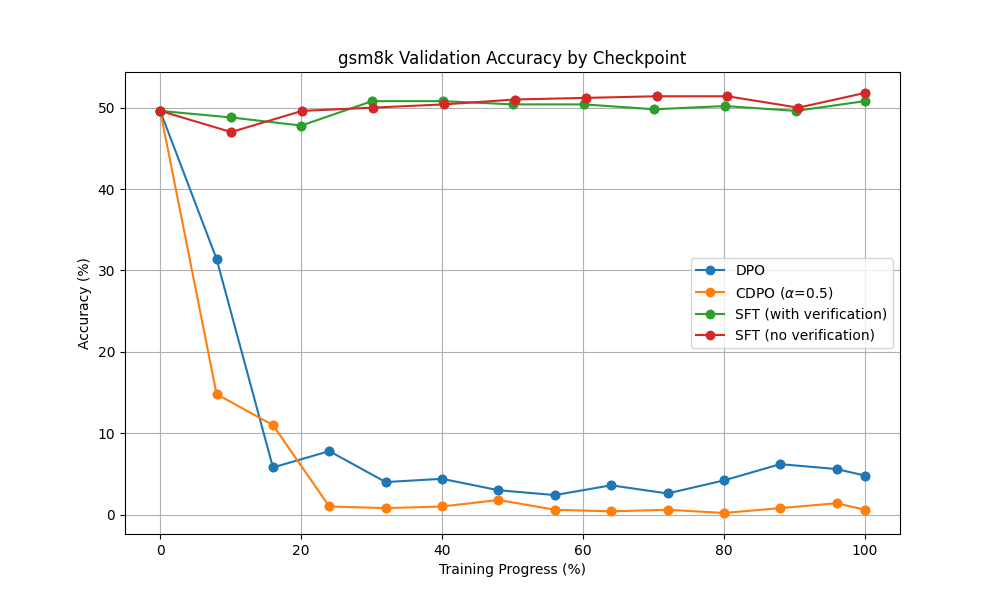
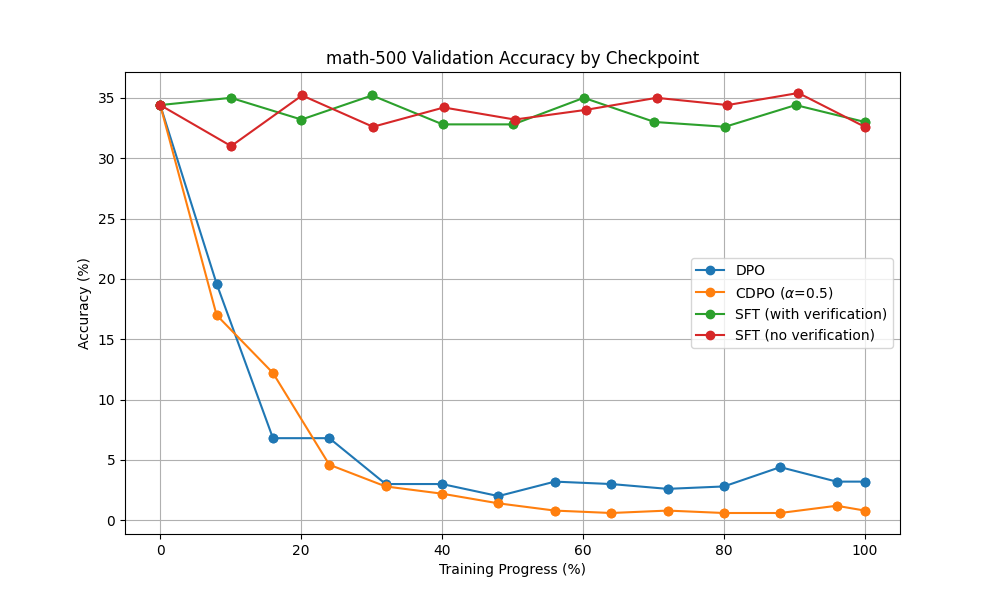
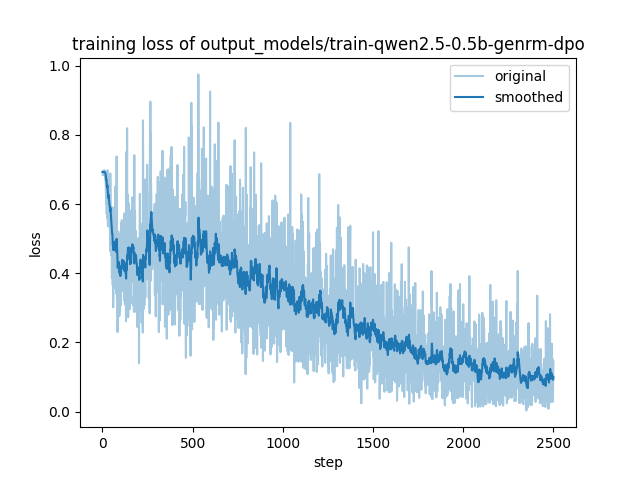
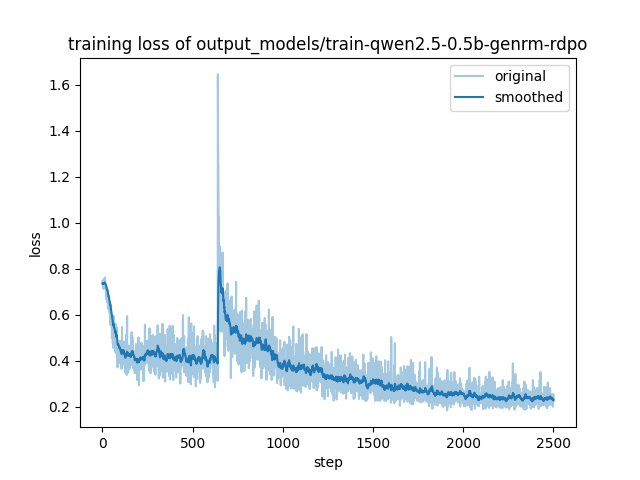
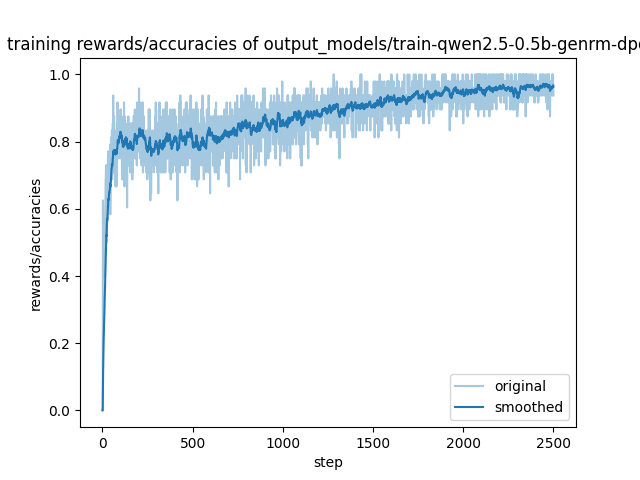
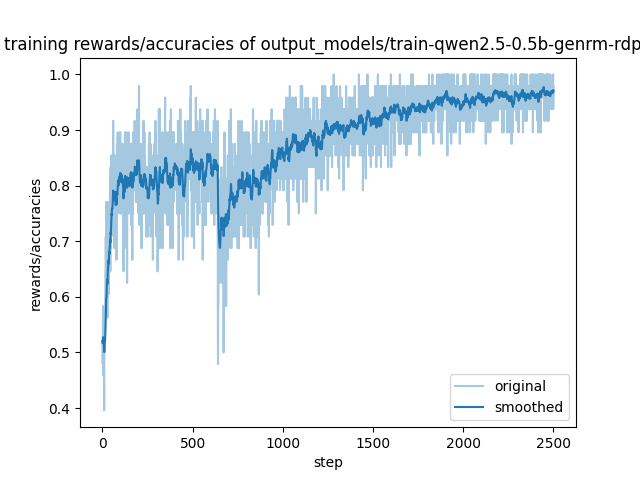
The figure below reveals the mechanism behind this collapse. Despite the catastrophic drop in downstream accuracy, both DPO and CDPO show smoothly decreasing training loss and reward accuracy approaching 1.0 throughout training. This suggests reward hacking: the model learns to separate chosen from rejected examples in the implicit reward space (by pushing log-probability ratios apart), but this optimisation does not correspond to improved generation quality — it instead degrades the model’s ability to produce coherent solutions.
Discussion
The dramatic collapse of both DPO and CDPO, combined with smoothly improving training metrics, is a well-known failure mode of DPO. Gao et al., 2025 identify exactly this pattern in text-to-SQL tasks: the implicit reward $\hat{r}_\theta$ can be inflated by superficial correlates that do not reflect reasoning quality — model performance initially peaks then decreases, while the implicit reward continues to rise. At the 0.5B parameter scale, the model appears to lack sufficient capacity to simultaneously maintain generation quality and satisfy the DPO preference margin. We identify two potential mechanisms behind this collapse:
Distributional mismatch. The verification rationale $c_v$ is generated by an external oracle whose writing style, reasoning depth, and vocabulary differ substantially from the base model’s natural distribution. This echoes findings from GenRM-STaR-DPO [Mahan et al., 2024], where off-policy rationales from a stronger model matched STaR-DPO in-distribution but collapsed out-of-distribution. CLoud [Ankner et al., 2024] similarly reports a 5.6% drop when training on oracle critiques versus self-generated ones, attributing it to distributional shift between training and inference.
Task conflict. The verification rationale is fundamentally different from the solution-generation task the model performs at inference. Verification text contains meta-analytical language (“Step 1: check…”, “Expected Answer: Correct”, “Verification: Is the answer correct? Yes/No”) that is absent from problem-solving. Training the model to produce both types of text may create a multi-task conflict that degrades performance on the primary task.
Conclusion
We proposed Critique DPO (CDPO), which extends the DPO objective with an auxiliary NLL term on a verifier’s chain-of-thought critique. We evaluated CDPO against DPO and SFT baselines on Qwen2.5-0.5B-Instruct using 120,000 math preference triples from the GenRM dataset, with evaluation on GSM8K and MATH-500. Our results are a negative finding: both DPO and CDPO suffer model collapse at this scale, with CDPO collapsing faster and more severely than vanilla DPO. The critique NLL term, intended to transfer the verifier’s analytical capabilities to the base model, instead exacerbates the well-documented DPO reward-hacking failure mode. Meanwhile, simple SFT on correct solutions provides modest but stable improvements, and adding verification rationales to SFT yields no additional benefit. Future work should explore: (1) on-policy critique generation (STaR-style self-generated rationales instead of off-policy oracle critiques), (2) larger model scales where the multi-task learning implicit in CDPO may become tractable.
References
Rafailov, R., Sharma, A., Mitchell, E., Ermon, S., Manning, C. D., & Finn, C. (2024). Direct Preference Optimization: Your Language Model is Secretly a Reward Model. arXiv:2305.18290. https://arxiv.org/abs/2305.18290
Wolfe, C. R. (2025). Direct Preference Optimization (DPO). Blog post. https://cameronrwolfe.substack.com/p/direct-preference-optimization
Romero, T. (2024). Direct Preference Optimization Explained In-depth. Blog post. https://www.tylerromero.com/posts/2024-04-dpo/
Bai, Y. et al. (2022). Constitutional AI: Harmlessness from AI Feedback. arXiv:2212.08073. https://arxiv.org/abs/2212.08073
Lee, H. et al. (2024). RLAIF vs. RLHF: Scaling Reinforcement Learning from Human Feedback with AI Feedback. arXiv:2309.00267. https://arxiv.org/abs/2309.00267
Li, A. et al. (2024). HRLAIF: Improvements in Helpfulness and Harmlessness in Open-domain Reinforcement Learning From AI Feedback. arXiv:2403.08309. https://arxiv.org/abs/2403.08309
Gao, H. et al. (2025). Uncovering the Impact of Chain-of-Thought Reasoning for Direct Preference Optimization. arXiv:2502.11656. https://arxiv.org/abs/2502.11656
Zelikman, E., Wu, Y., Mu, J., & Goodman, N. D. (2022). STaR: Bootstrapping Reasoning With Reasoning. arXiv:2203.14465. https://arxiv.org/abs/2203.14465
Hosseini, A., Yuan, X., Malkin, N., Courville, A., Sordoni, A., & Agarwal, R. (2024). V-STaR: Training Verifiers for Self-Taught Reasoners. arXiv:2402.06457. https://arxiv.org/abs/2402.06457
Pang, R. Y., Yuan, W., Cho, K., He, H., Sukhbaatar, S., & Weston, J. (2024). Iterative Reasoning Preference Optimization. arXiv:2404.19733. https://arxiv.org/abs/2404.19733
Shen, Y. et al. (2024). AIPO: Improving Training Objective for Iterative Preference Optimization. arXiv:2409.08845. https://arxiv.org/abs/2409.08845
Liu, Z. et al. (2024). Provably Mitigating Overoptimization in RLHF: Your SFT Loss is Implicitly an Adversarial Regularizer. arXiv:2405.16436. https://arxiv.org/abs/2405.16436
Wang, P., Xu, A., Zhou, Y., Xiong, C., & Joty, S. (2024). Direct Judgement Preference Optimization. arXiv:2409.14664. https://arxiv.org/abs/2409.14664
Zhang, L., Hosseini, A., Bansal, H., Kazemi, M., Kumar, A., & Agarwal, R. (2024). Generative Verifiers: Reward Modeling as Next-Token Prediction. arXiv:2408.15240. https://arxiv.org/abs/2408.15240
Mahan, D. et al. (2024). Generative Reward Models. arXiv:2410.12832. https://arxiv.org/abs/2410.12832
Ankner, Z., Paul, M., Cui, B., Chang, J. D., & Ammanabrolu, P. (2024). Critique-out-Loud Reward Models. arXiv:2408.11791. https://arxiv.org/abs/2408.11791
Yu, Y. et al. (2025). Self-Generated Critiques Boost Reward Modeling for Language Models. arXiv:2411.16646. https://arxiv.org/abs/2411.16646
Wang, Y., Yue, X., & Chen, W. (2025). Critique Fine-Tuning: Learning to Critique is More Effective than Learning to Imitate. arXiv:2501.17703. https://arxiv.org/abs/2501.17703
McAleese, N. et al. (2024). LLM Critics Help Catch LLM Bugs. arXiv:2407.00215. https://arxiv.org/abs/2407.00215
Xie, Z. et al. (2025). Teaching Language Models to Critique via Reinforcement Learning. arXiv:2502.03492. https://arxiv.org/abs/2502.03492
Qwen Team. (2024). Qwen2.5 Technical Report. arXiv:2412.15115. https://arxiv.org/abs/2412.15115
Cobbe, K. et al. (2021). Training Verifiers to Solve Math Word Problems. arXiv:2110.14168. https://arxiv.org/abs/2110.14168
Hendrycks, D. et al. (2021). Measuring Mathematical Problem Solving With the MATH Dataset. arXiv:2103.03874. https://arxiv.org/abs/2103.03874
We really mean unique equivalence class of rewards and its optimal policy; see Lemma 1 and Lemma 2 in Rafailov et al., 2024. ↩︎